
Despite initiating a massive bombing campaign and a combat operation against the Iran-backed terrorist organisation, Israel is still struggling to defuse the threat posed by Hezbollah’s fatal strike on an army post deep within Israeli territory.
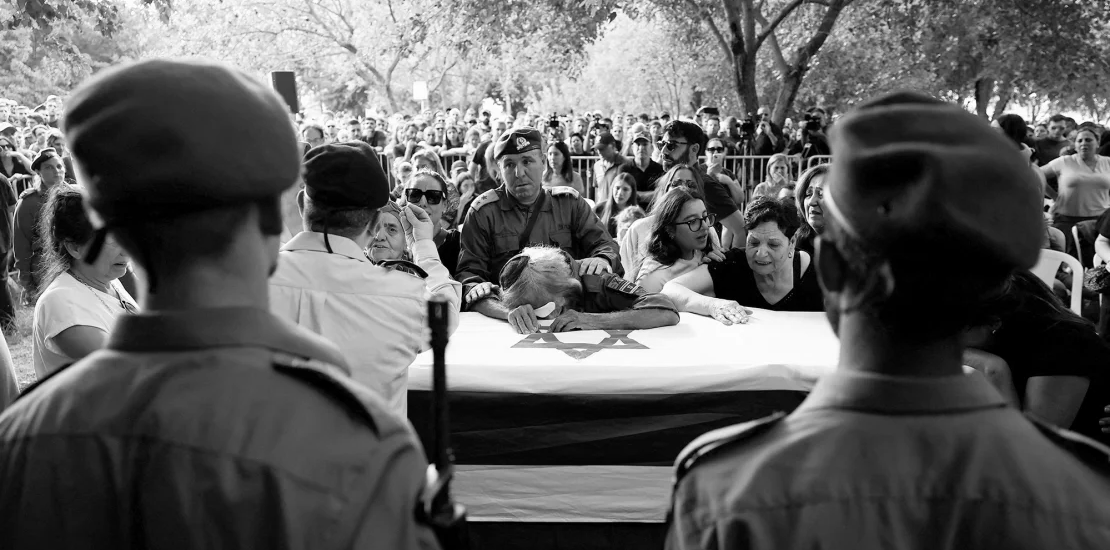
A drone that was launched from southern Lebanon managed to sneak past Israeli air defences and strike the Golani Brigade’s base some 40 kilometres inside Israel from the border. Although the military has not disclosed any information on the impact site, photographs taken at the scene show that the drone impacted the base’s dining hall on Sunday just after 7 p.m., which is dinnertime.
The strike’s timing and location imply that Hezbollah had acquired sufficient intelligence and had the means to inflict the greatest possible number of deaths. As part of Israel’s combat campaign in southern Lebanon, the Golani Brigade—which is considered an elite Israeli army unit—has been sent there.
At least 18 Israel Defence Forces (IDF) troops have been slain since the ground operation began two weeks ago, with four soldiers dead and over 60 others injured, including eight critically.
The attack on Sunday is also the worst to hit IDF forces inside Israel since the conflict started in October of last year.
It demonstrates that Hezbollah can still launch attacks, according to Daniel Sobelman, an international security specialist at the Hebrew University of Jerusalem.
After Hezbollah’s long-time leader Hassan Nasrallah and other senior officials were killed, he told CNN, “It is a clear indication that Hezbollah is regaining its strategic balance following the recent devastating blows to its leadership and command and control apparatuses.”
The majority of missiles aimed against Israel are intercepted and destroyed by Israel’s remarkable air defence systems. However, their primary purpose is to oppose rockets and missiles, not drones that can be fired from any location, fly slowly and low, and change course rapidly.
Although the IDF has not disclosed the kind of aircraft that was used in the strike on Sunday, analysts informed CNN that it was most likely a Mirsad drone, also referred to as Ababil drones in Iran.
Such unmanned aerial vehicles (UAVs) are more difficult to detect since they “are small in size, very light, with very low radar signature,” according to Orna Mizrahi, a senior research fellow at the Israeli Institute for National Security Studies (INSS) in Tel Aviv, who spoke to CNN.
After describing drones as “a weakness” for Israel, Mizrahi said that Iran and its allies are attempting to overwhelm Israel’s defence capabilities.
“They always find a new way to attack when we figure out a solution,” she added.
However, Hezbollah’s drone that was launched over the weekend got through without setting off Israel’s warning systems. There was an unexpected attack on the soldiers in the dining hall.
Furthermore, this was not the first time it had occurred.
Hezbollah published a nine-minute drone footage in June that showed both military and civilian sites in and around Haifa, one of Israel’s biggest cities. The IDF also didn’t seem to have seen that UAV.
The Israeli military was “preparing and coming up with solutions to deal with these and other capabilities,” according to then-IDF chief of staff Herzi Halevi, in reaction to the video.
Next, in July, a drone fired by Yemeni Houthi rebels supported by Iran killed one man and wounded at least ten others in Tel Aviv. During that attack, no sirens were sounded. According to the IDF, a human error caused two drones to be shot, one of which was intercepted while the other was not.
Hezbollah also seems to have copied the strategy of launching two drones last week.
The IDF says it intercepted one of the two drones that were fired from Lebanon on Friday, but it did not reveal the fate of the other. Although there were no reported injuries, the incident damaged a nursing facility in the central Israeli city of Herzliya.
The similar tactic was probably used on Sunday as well. The IDF claimed to have intercepted a UAV fired from Lebanon in Israel’s northern naval region just prior to the initial reports of the attack against the Golani Brigade base. This implies that a second aircraft fired either concurrently or just before or after the first drone that struck the base. Regarding the quantity of drones deployed on Sunday, the IDF remained silent.
Hezbollah claimed to have launched the drones and fired dozens of missiles at the northern Israeli cities of Nahariya and Acre in an attempt to interfere with Israel’s air defence systems.